
O'Fallon City Directory Shelves
O'Fallon historical-directory evidence is not a single annual shelf. The firmest local item is a 1929 excerpt drawn from Polk’s Belleville City Directory. It is held through the O'Fallon Historical Society and reproduced in its Summer 2008 Quarterly. A separate 1891-1892 Belleville directory reference includes a farmers and landowners appendix with O'Fallon post-office entries. Both are useful leads, but neither proves a complete run of yearly O'Fallon city directories. The St. Charles County Historical Society, area libraries, and statewide repositories supply the broader record trail.
| Collection | Years | Where Held | Access |
|---|---|---|---|
| O'Fallon City Directory excerpt | 1929 | O'Fallon Historical Society | View original at the museum; newsletter excerpt is online |
| Belleville directory, farmers and landowners appendix | 1891-1892 | O'Fallon Historical Society archive/newsletter reference | Confirm the original shelf before treating it as a full O'Fallon directory |
| St. Charles city and county directories | Area runs, including a referenced 1934 microfilm entry | St. Louis County Library History & Genealogy materials and area libraries | Staff confirmation needed for an O'Fallon page or run |
| Missouri Digital Heritage city directories | Varies by digitized run | Missouri Digital Heritage | Searchable online where a volume has been digitized |
| O'Fallon Progress | 1898-present stated archive span | St. Charles-area library or O'Fallon Historical Society index | Email the library with a focused name, date, and event request |
Library branch pages do not publish a year-by-year O'Fallon directory list. Ask for city, telephone, reverse, criss-cross, yearbook, newspaper, and local-history holdings rather than assuming a familiar title is present.
O'Fallon's 1929 Polk Clue
The verified 1929 material is best read as a directory-style snapshot. Its reproduced index has columns for “Name and spouse,” “Occupation,” “Comments,” “House #,” and “Street name.” It combines people with businesses and civic institutions. One captured business line identifies O'Fallon Battery Shop, occupant Melvin Titter, house number 207, and S Lincoln. Other entries identify aldermen by ward and Board of Education names and roles. The Quarterly editor says that some original abbreviations were written out for clarity.
| Name and spouse | A person may appear with a spouse, initials, or a related household clue. |
|---|---|
| Occupation | Work or a business connection that can distinguish people with the same name. |
| Comments | Context supplied by the excerpt, not a standard modern contact field. |
| House number and street | The address wording printed in the source, which should be copied exactly. |
| Institutional entry | A civic body or business may lack a household-style address and should not be read as a resident listing. |
This inventory does not establish owner or renter marks, a full reverse section, or other fields not visible in the inspected source. The original directory page was not available as a complete high-resolution scan, so a missing field must remain unknown.
O'Fallon Directory Names Under Belleville
Historical O'Fallon searches can fail because the place label changes before the name does. The known 1929 excerpt came from a Polk’s Belleville directory, and the 1891-1892 reference is a Belleville directory appendix. O'Fallon developed as a railroad-centered farming town, and older material may appear under Belleville, St. Charles County, a post-office name, or a nearby town. Search each label, plus O'Fallon, O Fallon, and O FALLON when an index normalizes the apostrophe.
That geography matters for family history. O'Fallon began as a railroad-linked settlement in the 1850s and incorporated in 1912 with about 600 residents. It remained roughly 20 blocks square into the early 1970s. An old address or post-office description may not match a current boundary, street pattern, or ZIP label. Preserve the place heading shown by the source and compare it with plats, directories, and county material before merging two similar records.
Note: A Belleville heading is a search route, not proof that a person lived in Belleville or that every O'Fallon household was included.
Reading an O'Fallon City Directory Entry
Copy the full line before deciding what it means. Start with the surname, initials, alternate spellings, spouse notation, occupation, business affiliation, house number, and street spelling. A name beside a business might show an operator, employee, or civic role rather than a home address. A missing number can reflect an institutional entry. Separating those possibilities keeps a city directory from becoming a claim about a person’s current life.
- Criss-cross directory
- A directory arranged by street and number instead of by surname. The researched O'Fallon run is not verified as having one, so ask a library or archive for any reverse or street-order volume.
- Householder index
- A name-based finding aid for the person listed as the household head. It may omit boarders, adult children, and other occupants.
- Abbreviation key
- The volume’s guide to shortened terms. Photograph or transcribe it before interpreting occupation or relationship notes.
When a line seems to identify a person, use the address and occupation as separate checks. The local historical collection is valuable precisely because it can connect a brief entry to clippings, photos, or topic files without turning one directory line into a full biography.
O'Fallon Progress and Local Files
The O'Fallon Historical Society archive keeps resident files, photographs, documents, stories, and newspaper clippings shared by local historians and family researchers. The O'Fallon Progress archive is stated to begin in 1898, while the Historical Society has indexed obituaries and marriage announcements. A newspaper item can date a move, a death, a marriage, a civic role, or a business connection that a directory line only hints at.
Send a narrow request to a library contact: full name, approximate date, event type, and any known street or organization. Broad searches create more false matches, especially when names repeat. The Baue Funeral Home Records Index at SCCHS is another endpoint for a death or burial search, but its published fields are limited to last name, first name, death date, and a funeral-home record number.
O'Fallon Directory Requests at SCCHS
St. Charles County Historical Society holds county and city material from 1800 to today, including wills, probate, circuit-court, naturalization, land and property, business, church, cemetery, census, obituary, and burial indexes. It also holds diaries, journals, scrapbooks, personal papers, and historic-property files with tax or assessor material and photographs. The archive is at Old Market House in St. Charles. It is open Monday, Wednesday, and Friday from 10 a.m. to 3 p.m., with Saturday research by appointment.
Its Research Request route matters because original documents behind its online indexes are not online. The request should identify the surname, date range, record type, locality, and any citation already found. The St. Charles City-County Library’s Genealogy & Local History resources are the practical first referral for databases and help locating newspapers, yearbooks, directories, and microfilm. The exact O'Fallon shelf run must still be confirmed with staff.
Note: An index hit is a pointer to an original, so retain the original spelling, source title, and page or record number with every request.
O'Fallon City Directory Library Access
The St. Charles City-County Library Genealogy & Local History page points readers toward genealogy research resources and the library system’s local-history referrals.
Library staff can help distinguish a catalog lead from a confirmed volume and can route a focused request when a directory, newspaper, yearbook, or microfilm title is not posted online.
The Middendorf-Kredell branch page documents an O'Fallon library facility with public computers, Wi-Fi, scanning, copying, and notary service.
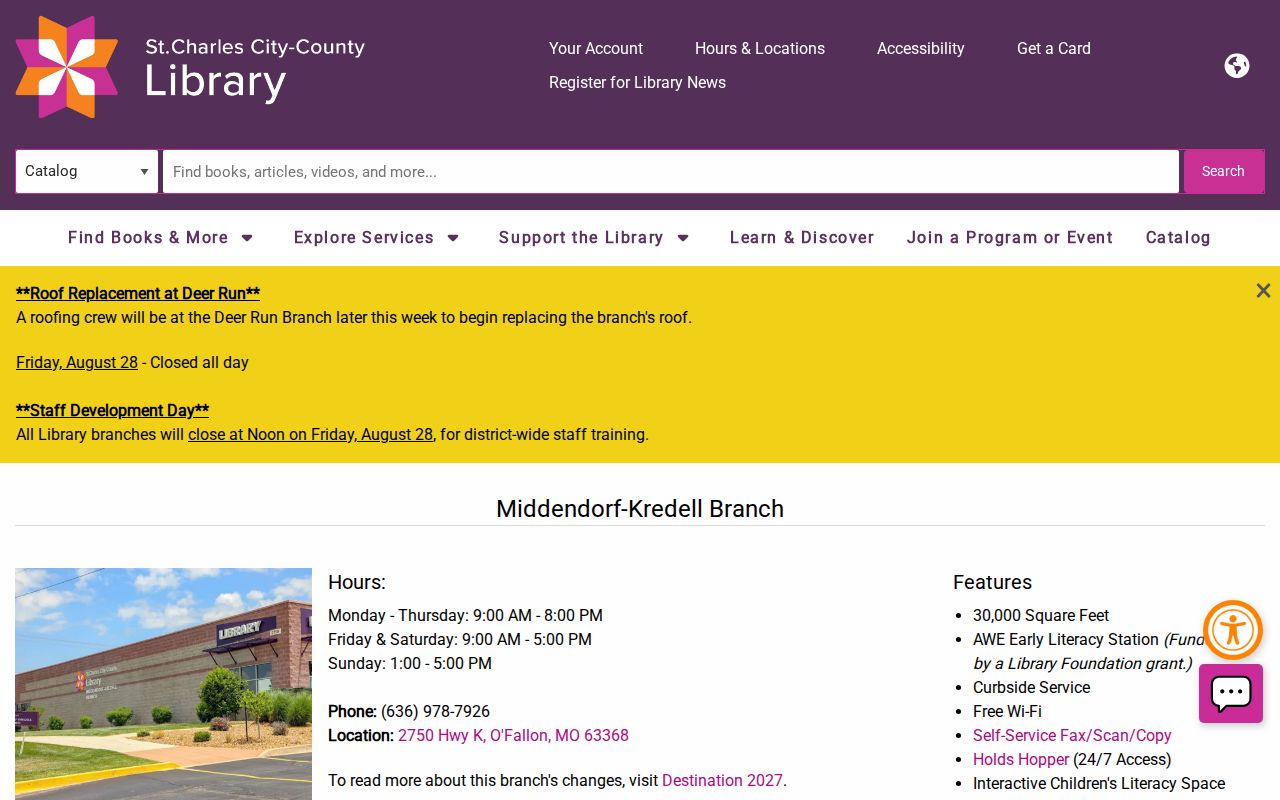
Those access tools support careful note-taking and image capture, but staff confirmation remains necessary for exact city-directory, reverse-directory, and telephone-book years.
Tracing O'Fallon City Directory Households
Use a sequence rather than a single entry. A household can move, change occupations, be listed under initials, or disappear after a marriage, death, or business change. The goal is to build a dated trail and label each link by source. For the property side of a historic address, the O'Fallon previous residents search follows the deed chain without repeating the historical shelf work here.
- Find the earliest confirmed name or address line and copy it exactly, including the place heading.
- Check nearby directory years or related Belleville and St. Charles headings for spelling, spouse, occupation, or street changes.
- Put each address and work description into a dated timeline, keeping institutional entries apart from household entries.
- Pair the directory trail with the appropriate released federal census, then compare a death, obituary, or burial lead.
- Request the underlying SCCHS record or local archive file when an index supplies a promising citation.
A vanished listing proves little by itself. The household may have moved, remarried, died, changed a business name, or simply been omitted. Use an obituary, cemetery index, probate docket, or land record as corroboration rather than choosing the most convenient explanation.
O'Fallon Census Timing and Gaps
Federal census access follows a 72-year rule, so released schedules are best used as a dated household check alongside city directories. The 1890 population schedules were destroyed in a national fire. A partial Civil War Veterans and Widows schedule survives, but it is not a replacement for the lost population census. Missouri’s uneven early vital registration also makes church, cemetery, probate, land, and newspaper material important when a directory trail reaches the nineteenth century.
| 1798-1898 | SCCHS lists early deeds in its holdings; use county archives and request channels for deeper work. |
|---|---|
| 1890 | The federal population schedule is lost nationally; use the surviving special schedule where relevant and seek local substitutes. |
| 1891-1892 | A Belleville directory appendix provides a verified O'Fallon post-office lead, not a confirmed complete local shelf. |
| 1929 | The O'Fallon Historical Society holds the verified Polk’s Belleville directory excerpt. |
| 1898-present | The stated O'Fallon Progress archive span offers newspaper leads between directory and census dates. |
O'Fallon Railroad-Era Directory Clues
Nicholas Krekel, identified by local history as O'Fallon’s first resident, retailer, postmaster, and railroad agent, shows why occupation fields deserve attention. Railroad, depot, merchant, church, school, and civic terms can point to records beyond a surname list. His brother Arnold Krekel plotted the town and donated land for the railroad. Those facts do not identify any later resident, but they explain why local files, city minutes, newspapers, business material, and land records can add context to an old directory line.
Do not assume that a historical directory is complete or that a missing person was absent from town. No verified exact O'Fallon reverse-directory run, full annual shelf list, or O'Fallon-specific online city-directory run was located in the inspected sources. Mark the gap, retain the search terms, and use the library, O'Fallon Historical Society, SCCHS, and Missouri State Archives as the documented referral chain.