
O'Fallon Previous Residents by Era
Each record answers a narrower question than “who lived here before.” A recorded deed documents a transfer, an assessor record identifies a parcel for assessment, a historic directory may supply a household or business clue, and a permit can date work on the structure. Begin with the era you can place with confidence. The table keeps the documented coverage separate from coverage that has not been verified for a particular shelf or map.
| Source | Years | Where Held | What It Shows |
|---|---|---|---|
| Recorder online index | 1972-current | Fidlar Tapestry and Laredo | Searchable grantor, grantee, and instrument trail |
| Recorder images | November 16, 1804-current verified date | Laredo, Tapestry, or Recorder office | Deed and legal-description images, with weaker early name indexing |
| SCCHS deed and property holdings | Deeds listed 1798-1898; property material 1800-today | St. Charles County Historical Society archives | Early ownership, land, tax or assessor material, and photographs |
| O'Fallon directory excerpt | 1929 | O'Fallon Historical Society | Name, spouse, occupation, comments, house number, and street |
| O'Fallon Progress | 1898-current stated archive span | Library or Historical Society index | Obituaries, marriage announcements, and local names or addresses |
| Federal census | Released schedules under the 72-year rule | NARA, FamilySearch, or library resources | Household, age, relationship, occupation, and address or tract context |
Current City Building material can add a permit or inspection date, but its older coverage range is not published. Use it as a construction clue, not as a list of prior occupants.
O'Fallon Previous Residents and 1972
The Recorder’s two dates matter. Laredo’s searchable index begins January 1, 1972, while its images begin November 16, 1804. That means an old document image may survive even when the online name index is not deep enough to find it by a direct surname search. Do not treat the image date as proof of a searchable 1804 name index. Use the legal description, book and page citation, or an earlier instrument reference to reach older material.
St. Charles County Land Records describes two remote access paths. Tapestry is the occasional-user, pay-per-search option, and Laredo is subscription access for frequent use. The Recorder research room is a documented fallback: searching is free on weekdays, self-service prints cost $1 per page, and the research area closes at 4:30 p.m. even though the office remains open until 5 p.m.
The Recorder land-records page is the official source for the portal choices, office research route, and coverage guidance.
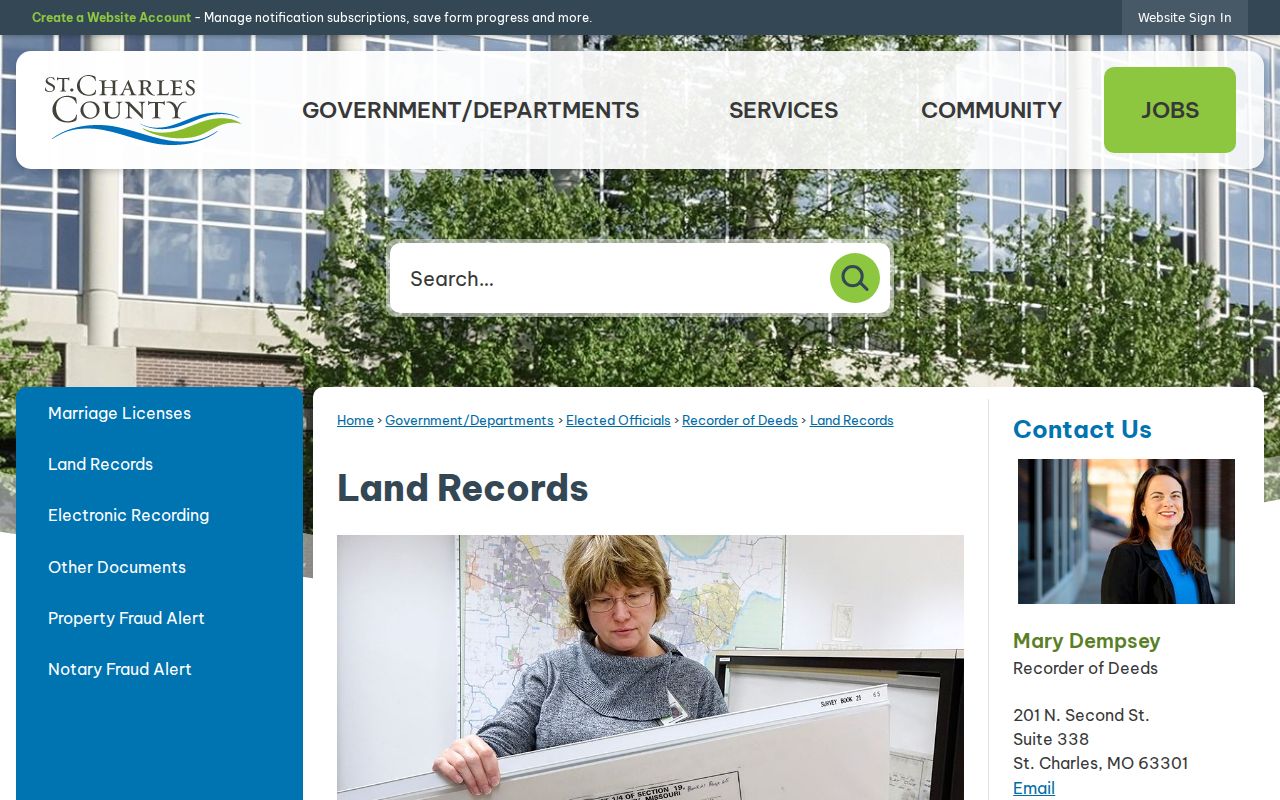
Use the page to choose the route that fits the date and citation in hand, then keep the instrument number, recorded date, and source of each image in the property timeline.
O'Fallon Previous Residents Before the Index
For work before 1972, the public research terminal, historic indexes, book and page citations, legal descriptions, and the county archives are more useful than repeated name-only searches. The Recorder guide lists grantor or grantee, document number, recording-date range, legal description by subdivision or metes and bounds, and document type as search routes. The county warns that not all legal descriptions are indexed, so a missing result is a reason to try another record key, not proof that no document exists.
St. Charles County Historical Society lists early deeds from 1798-1898 and broader property material from 1800 to today. Its online indexes do not put every original online. A Research Request, an onsite visit, or a Recorder research-room search is the documented path when an old reference needs an underlying document. Missouri State Archives county microfilm guides are another verified referral point for deeper county material.
Note: Tapestry search fees and Laredo subscription access are different services, while free office searching remains available for a weekday visit.
O'Fallon Deed Chain for Past Owners
A chain of title follows transfers in reverse. First use the St. Charles County Assessor property database to identify the current assessed owner, parcel or account number, and legal description. The assessor helps pin down the parcel, but it is assessment information, not title verification. A mailing address is not the parcel’s situs address, and neither field proves who occupied the property.
- Copy the current owner name, parcel identifier, subdivision or legal description, and the situs address from the assessor record.
- Search the Recorder index for the current owner as grantee and use the legal description or subdivision when a street address does not appear.
- Open the purchase deed. Record its grantor, recorded date, document number, and any prior book, page, or instrument citation.
- Search that earlier owner as grantee to locate the purchase that preceded the sale, then repeat the cycle backward.
- Check document type at every step. A quitclaim, deed of trust, release, lien, or plat may be important but does not always transfer title.
- When the trail reaches the index boundary, take the citation to the Recorder research room or SCCHS rather than guessing from a matching surname.
- Grantor
- The party conveying an interest in a recorded instrument. In a purchase deed, this is often the seller.
- Grantee
- The party receiving an interest in the instrument. In a purchase deed, this is often the buyer.
- Chain of title
- The ordered sequence of recorded transfers for a parcel or legal description.
- Legal description
- The lot, block, subdivision, metes-and-bounds, or other formal land description that can outlast a changing street address.
O'Fallon Addresses and Post Office Labels
Address continuity is a local records-geography problem. O'Fallon incorporated in 1912, stayed roughly 20 blocks square until early-1970s growth, and later expanded with subdivisions and infrastructure. An old directory may use a rural route, old post-office label, Belleville heading, or location outside current city limits. The confirmed 1891-1892 Belleville appendix and 1929 Polk’s Belleville directory excerpt make this more than a theoretical issue.
Keep the old street name, post office, legal description, and source date together. Compare them with recorded plats, city-limit or annexation documents, and county GIS context. No official street-renumbering or street-renaming project with a verified date was found in the research. A mismatch should remain a documented gap until a plat, ordinance, directory, or recorded description bridges it.
O'Fallon Previous Residents in 1929
Use the verified 1929 O'Fallon excerpt as a time marker, not a complete roster. It was extracted from Polk’s Belleville City Directory and shows name and spouse, occupation, comments, house number, and street name. The material also contains businesses and civic institutions. A household line can help place someone at an address during that year, while a business entry may only establish a connection to the street or town.
For the collection’s details and its Belleville indexing trap, the O'Fallon city directory page focuses on how to read the historical volume. Use a directory line together with a deed date, census record, obituary, or newspaper mention before stating that a named person was a past occupant.
O'Fallon Households Between Census Years
Ownership is only one layer of house history. A directory or census can suggest household members, boarders, adult children, or a business at the address, but each has its own date and coverage limits. Federal schedules become available under the 72-year rule. The 1890 population schedules were destroyed by a national fire, although a partial Civil War Veterans and Widows schedule survives. Do not fill the 1890 gap by claiming a census result that no longer exists.
- Place the address or household in a verified directory or newspaper date.
- Use the nearest released census to check names, ages, relationships, and occupation context.
- Compare the next directory, obituary, marriage announcement, or deed transfer for a move, death, or change in household.
- Use the O'Fallon Progress, SCCHS obituary or funeral index, and probate docket as corroborating endpoints.
SCCHS holds church, cemetery, census, obituary, burial, and probate indexes, while the O'Fallon Historical Society holds local resident files and clippings. Those sources can make a household trail more precise without pretending that every renter or family member appears in every public record.
Lawful use. O'Fallon house-history research is for family history, estate questions, personal curiosity, and understanding a property. Do not use a past address trail to track, harass, or harm any living person.
O'Fallon Previous Residents and Permits
O'Fallon Building and Permits uses CitizenServe for applications, status, documents, fees, and inspection scheduling. Its permit categories include new homes, decks, sheds, pools, basement finishes, additions, major alterations, and occupancy permits. A project date can help date construction or a major change. It does not establish a sale, an ownership transfer, or the identity of every person who lived there.
For older or closed city files, contact City Building or the City Clerk through Missouri Sunshine Law procedures. The research confirms that older city records can require a counter contact or request, but does not identify a dedicated O'Fallon house-history guide or a published historical permit range. State the address, date range, permit type, and desired format when requesting a record.
O'Fallon Previous Residents, Honest Gaps
Several tempting shortcuts remain unverified. No exact O'Fallon Sanborn fire-insurance map run or local shelf location was found, though the Library of Congress Sanborn collection, local library catalogs, and State Historical Society catalogs are appropriate places to ask. No dedicated municipal house-history service page, complete historical reverse-directory run, or verified street-renumbering event was located either.
Those gaps shape the safe workflow. Follow the deed chain with the legal description, preserve original place labels, pair a directory date with released census and newspaper material, then request originals from SCCHS or the Recorder. A record that cannot be verified should stay a lead, not become a conclusion about past residents.